

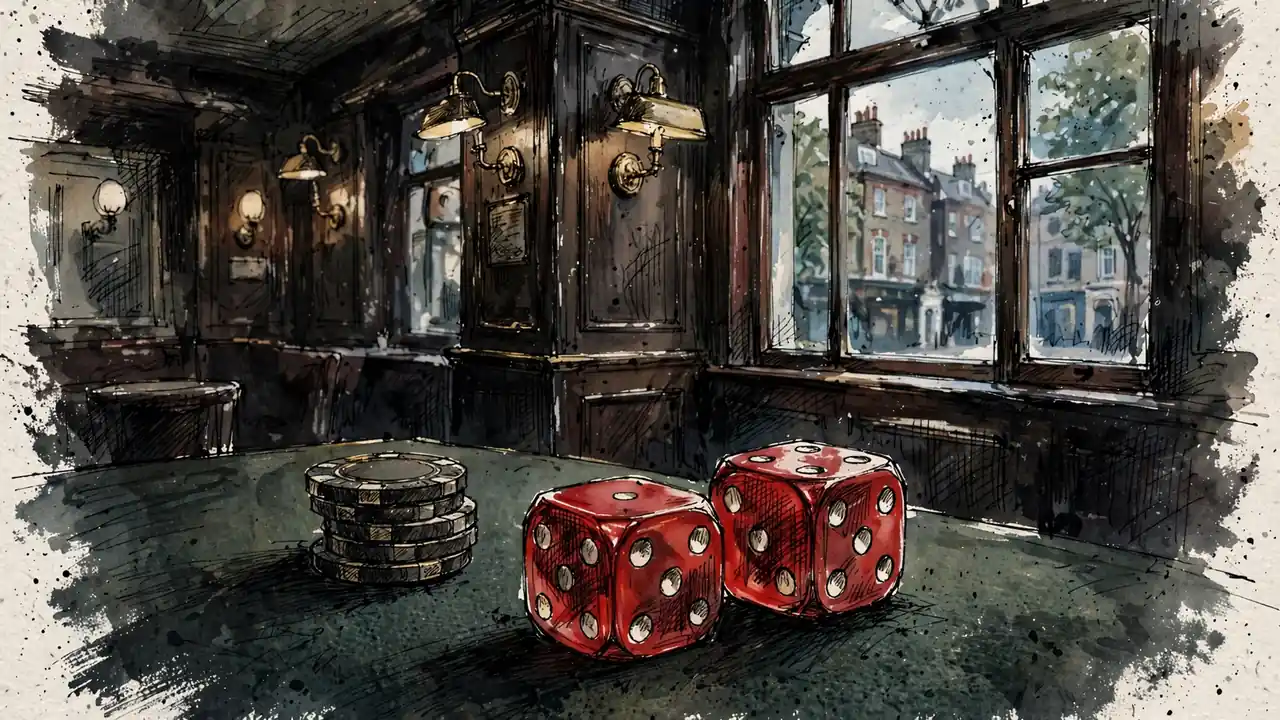
A search term or broad casino-games claim cannot confirm that a playable, real-money craps title is available.
Real-Money Craps: What the Search Term Does—and Doesn’t—Establish
A request for online craps with real money combines two separate ideas: a particular casino game and the possibility of staking cash on it. The wording can sound like evidence that the game is available somewhere in the UK market. It is not. It tells me what a person is looking for, not what any casino currently offers.
That distinction matters because a game name can travel further than the product itself. A page may mention craps in a general description, discuss it as a game found in casinos, or use the term to attract people interested in it. None of those things establishes that a playable craps game is present in a UK-facing casino lobby, still less that it can be played for real money. Description is not access.
The reverse is also true: a casino’s general claim to offer online games does not establish that its catalogue includes craps. A broad label such as “casino games” covers a range of products, and it does not identify every title or format available. The detail has to be tied to an actual game and an actual offer. Otherwise the wording does more work than the evidence.
I have seen this kind of gap create false confidence. A page can place “real money” beside a game name and make the combination look settled, even when the text has not shown that the game can be opened, that stakes are accepted, or that the offer is meant for British customers. Those are different claims. One phrase cannot prove all of them.
There is also a difference between a game being discussed and a game being supplied as a consumer product. A provider’s name, a general catalogue statement, or an industry reference would not by itself show that a specific UK casino offers craps. The product has to reach a casino’s own service before it becomes relevant to a player there. That is why a search for a craps casino game cannot be treated as a result in itself.
Slot Providers: UK Casino Guides by Studio
The word “available” needs care, too. It might mean a title exists somewhere, that it appears in a particular casino’s catalogue, or that the game can currently be launched for real-money play by a customer in the UK. Those meanings are not interchangeable. A static description can remain visible after an offer changes, and a catalogue entry alone may not establish the conditions under which the game can be played.
For the same reason, “real money” is not a decorative qualifier. It separates a cash-stake offer from a description, demonstration or other non-cash presentation. If a page does not make that distinction clear, its use of the term leaves an important part of the claim unresolved. It may describe the subject the reader wants, but it does not confirm a playable cash-stake product.
The UK context adds a further boundary. Remote gambling offered to consumers in Great Britain must be provided under the relevant UK Gambling Commission licensing framework. A game name on a page does not establish that a lawful UK offer exists, and a reference to a casino game is not a substitute for evidence of the service behind it. That is a matter of what is being offered, not of how confidently the copy describes it.
UK Online Casinos: How Slot Supplier Games Appear
This is where seemingly precise wording can mislead. “Craps online casino” may sound like a product category, while “real-money casino craps” may sound like a confirmed feature. In practice, each is only a description unless it is connected to a specific, current offer. The phrasing can express intent accurately and still leave availability unanswered.
I would therefore separate the claim into its parts before treating it as meaningful: is there a craps title, is it actually accessible through a casino service, and is real-money play offered to customers in the relevant market? If one part is missing, the full claim has not been established. No amount of repetition repairs that gap.
This is not a technicality. A reader deciding whether a game is worth pursuing needs more than a page that echoes the desired wording. They need a clear distinction between a subject being mentioned and a product being offered. Marketing language often compresses those into one line. The underlying facts do not.
A request for real-money online craps in the UK should be understood as a description of the desired experience, not as proof that a particular casino provides it. The game term identifies the subject; the money term identifies the intended mode of play.
So a request for real-money online craps in the UK should be understood as a description of the desired experience, not as proof that a particular casino provides it. The game term identifies the subject; the money term identifies the intended mode of play. Neither identifies a verified offer. That is the limit of the wording.
Craps at UK Online Casinos: The Operator Is the Key
A casino’s country label does not establish which games it carries. For craps in the UK, the important distinction is between the company that supplies a game and the operator that makes a casino available to customers. The operator is the business responsible for offering remote gambling to the public; the supplier, where one is involved, is not a substitute for that business.
The UK Gambling Commission regulates gambling activity in the UK, including online casinos. In Great Britain, it is the sole regulator for commercial gambling, and its remit covers remote gambling offered to consumers there even when the equipment used to run the service is located elsewhere. That makes the operator’s legal position central. A platform serving Great Britain cannot rely on the physical location of its servers to avoid the local regulatory framework.
There is a practical point behind that rule. A company can operate technology from one place and take customers from another, but the customer-facing gambling business is still accountable for the market it serves. I have seen how easily a product page can blur these roles: a provider’s name may be prominent, while the legal operator is less visible. They are different jobs. One supplies; the other offers the gambling service.
Amatic Games at UK Online Casinos: What to Know
A licence does not describe a game lobby
The Gambling Commission issues operating licences to businesses and personal licences to individuals working in relevant roles in Great Britain. An operating licence concerns the business and its authorised activity; it is not a catalogue entry confirming every game available on a particular casino site. A regulator’s existence, or an operator’s regulated status, therefore cannot by itself establish that craps is in that operator’s lobby.
That distinction matters when a page describes a casino as a place to play craps. The claim is about a specific product being available through a specific operator, not merely about the general status of online casinos in Britain. A licence does not turn a possible game into a listed one. Nor does a broad casino description prove that a particular table game can be opened, played for money or accessed by every customer.
This is where promotional language can mislead without being technically elaborate. “Casino games” sounds comprehensive, but it may be a general description of a service rather than a promise about each named game. “Available” can also conceal details: a title might appear in a catalogue but not be accessible in a particular account or location. The wording needs to match the evidence. Broad labels are not inventory.
DO
- Identify the operator responsible for offering the gambling service.
- Check the operator’s legal position and regulatory status.
- Distinguish between the game supplier and the casino operator.
DON’T
- Rely on the physical location of a provider’s servers to avoid local regulations.
- Use a supplier’s name as a substitute for the business offering the service.
- Assume a game is available just because it is listed in a general catalogue.
Great Britain and the wider UK label
The phrase “UK casino” is common, but the Commission’s stated remote-gambling remit applies to consumers in Great Britain. The UK is not a single regulatory shorthand for every territorial question. The Gambling Act 2005 applies in England, Wales and Scotland; Northern Ireland is outside that Act’s scope. As a result, a statement about the Commission’s role in Great Britain should not be casually stretched into a claim about every part of the UK.
For a casino serving customers in Great Britain, the operator is the relevant business to identify in the regulatory relationship. The supplier of a game does not take over that responsibility simply because its name appears in the lobby or on a title screen. The operating business is the one offering the remote gambling service under the applicable framework. That is the useful distinction—not the visual prominence of a brand.
Craps availability remains a separate question from the regulatory structure. The rules explain who oversees commercial gambling and which businesses need operating licences; they do not establish that a named operator currently provides craps. A lawful market can contain many kinds of games, but the existence of that market does not confirm the presence of any one title or format. Licence and inventory are different records.
When I assess a statement about a UK casino, I separate those two matters before taking the wording at face value. First comes the identity and regulatory position of the operator. Then comes the narrower claim about the game itself. Combining them into one assertion—“regulated casino, therefore craps available”—skips the point that needs checking. Clean distinction. No shortcut.
That is why the operator, rather than a general reference to UK casinos, is the right starting point for understanding the market. The Commission’s role provides the framework for remote gambling in Great Britain, while each operator’s actual offering is a matter of its own service. Regulatory context can clarify responsibility, but it cannot serve as proof of a craps table.
Amatic Games at UK Online Casinos: A Supplier Guide
Assessing Online Craps Casinos Without an Unsupported Shortlist
A casino recommendation needs to establish more than a familiar name and a page labelled “table games”. I have seen how those labels can do useful work for a lobby while saying very little about a particular title. A category may describe a broad product area, not confirm that craps is available to British customers, playable for real money, or supplied by the operator at the time of checking.
That distinction matters when comparing casinos for craps. The operator is the business taking deposits and paying winnings; a game provider supplies software. One cannot stand in for the other. A provider’s presence in the market does not prove that any named casino carries a craps game, and a casino’s general licence does not establish its current game catalogue. A shortlist built from either inference is not a shortlist of confirmed craps options.
What a defensible recommendation needs
I would want to see direct, current evidence from the casino itself: a craps title in its live lobby, available to customers in the relevant market, with the game opening in the operator’s own environment. A provider catalogue or a page on an affiliate site can point towards a lead, but it cannot settle availability at the operator. Games can be added, removed, or restricted, and a catalogue entry may not reflect what a customer can actually access.
Amatic Casino Games in the UK: How Operators Offer Them
The next check is whether the title is offered for real-money play, rather than appearing only in a promotional image, archived review, or free-play demonstration. “Available” can be an elastic word. In practice, it may mean that a game once appeared on a platform, that the operator offers the provider’s other games, or that a demo can be opened. Those are not equivalent to a currently playable craps game.
The operator’s UKGC licence also needs to be checked against the Gambling Commission’s public register before a recommendation is made. That establishes the operator’s regulatory standing; it does not confirm that craps is in its lobby. Both checks matter, and neither replaces the other. A licence is not a game list. A game list is not a licence.
Why familiar casino names are not enough
Large operators often carry extensive catalogues, and that can make a guess feel reasonable. It is still a guess. A casino may offer many table games without offering craps. It may also use different suppliers across products or markets. Brand recognition, a broad lobby, or a history of carrying other casino games does not prove a craps offering.
Amatic Slots in UK Casinos: Games and Terms
The same caution applies to provider claims. A software company can be authorised to supply games to licensed operators without operating a consumer casino itself. Its regulatory status says something about its role in the supply chain, not which operator has chosen to integrate a particular title. In my experience, this is where recommendation copy can slide from a valid supplier fact to an unsupported casino claim.
A “best” ranking needs a further layer of evidence. First comes confirmed availability; only then can meaningful comparisons begin. The criteria might include whether the game works as described, how clearly the operator presents its terms, and whether the relevant customer-service and account information is accessible. Without a verified set of casinos offering craps, ranking them by quality, value, or suitability has no solid foundation. Polished tables do not fix that gap.
How to read a casino claim
A useful claim names the operator and the specific game, then makes clear what was checked and when. It should not blur a provider’s general distribution, an operator’s overall licence, and a particular craps title into one statement. If the evidence is an operator’s own lobby, that is different from an old review or a third-party catalogue. The wording should reflect the evidence rather than make all three sound equally conclusive.
I also treat “best” as a conclusion, not a decoration. It implies comparison. If a page cannot show which casinos were confirmed, what was compared, and why one ranked above another, the label is doing more persuasive work than the evidence. A list of familiar brands may satisfy the eye, but it leaves the central question unanswered: does each named casino actually offer craps to its British customers now?
For this reason, I would not turn adjacent facts into recommendations. A casino known for slots, an operator licensed in Great Britain, or a provider active in the UK market may each be relevant background. None independently supports the statement that the business is a UK craps casino. A careful assessment keeps those categories separate and avoids presenting possibility as availability.
The honest result
No named casino can be recommended as a confirmed craps venue based on an assumption alone.
The honest result, where operator-level confirmation is absent, is not a padded ranking. It is a clear limit: no named casino can be recommended as a confirmed craps venue on that basis. That may look less helpful than a “top” list, but it avoids sending a reader to an operator on the strength of an assumption. Evidence first. Then comparison.
Reading a Craps Table: Bets, Turns and the Flow of Play
A craps table can look self-explanatory because its betting areas are marked with familiar terms. That appearance is misleading. A label tells a player what a control is called; it does not, by itself, explain when a bet can be placed, what event settles it or whether it remains active afterwards. I treat those as separate questions. The table layout is a map, not a complete rulebook.
The first task is to identify where the game explains its own rules. In a digital version, that may be a help panel, paytable or information button. The wording matters more than the graphic. A bet name may be presented prominently while the conditions governing it sit behind a smaller information link. The useful detail is the full sequence: when the selection is accepted, what result triggers a win or loss, and what happens to the stake after that result.
Amatic Games at UK Online Casinos: What to Check
Read a bet as a set of conditions
Rather than choosing a bet by name, read it as a set of conditions. Look for the point at which it becomes active, the outcomes that affect it and how it is settled. If the explanation does not make those points clear, the display alone is not enough to establish the rule.
This is where promotional wording can obscure the mechanics. “Simple” may describe the number of clicks, not the number of conditions attached to a wager. “Flexible” may refer to the available selection, not to when the selection can be changed. I separate the sales language from the operating instructions. The latter should say what the game will do.
A table may show several betting areas at once, but visibility should not be confused with availability. Some controls may depend on the current state of play; others may remain selectable. The game’s instructions should clarify whether a selection is accepted immediately, held for a later point or unavailable at that moment. If the interface gives no clear confirmation, it is difficult to know what action has actually been registered.
Follow the state, not just the dice
The central reading skill is tracking the game’s state as it changes. A result on screen may begin a new phase, continue an existing one or settle a wager. Those are not interchangeable events. I watch for the game’s own prompts and status indicators rather than assuming that every roll has the same significance.
Reading the state
Step 1: Identify the current state
Identify the current state of the game.
Step 2: Check choices
See which choices are open and if the game confirms the selected action.
Step 3: Read the result
Read the result and its effect on the wager.
A useful mental sequence is: identify the current state, check which choices are open, see whether the game confirms the selected action, then read the result and its effect on the wager. This is not a substitute for the rules. It is a way to stop one visual event from being mistaken for another. A displayed result and a settled bet are related, but the game’s settlement message is the clearest indication of what happened to that stake.
The pace can make this harder. Animations, sound and changing highlights draw attention to the dice, while the relevant information may be in a status line or bet record. I give the confirmation more weight than the animation. If the game provides a history or transaction panel, it can help distinguish a new action from a result that belongs to an earlier stage.
Check what happens to an unsettled bet
A wager is not fully understood until its ending is clear. The rules should explain whether it is resolved by a particular result, stays active through a change in state, or must be selected again. Those details affect how a table is read from one turn to the next. A highlighted area may indicate a current selection, but it should not be treated as proof that the game will carry it forward.
The same caution applies when changing a selection. A control that appears clickable may not alter a wager already in progress. The instructions should state whether edits apply to the current game state or only to a later opportunity. I do not infer that from colour or placement: interfaces use visual emphasis for many purposes.
ELK Studios Online Casinos UK: What Can Be Verified
This is also why a quick scan of the layout is not enough to compare two games. Similar labels can sit within different presentations, and the decisive detail is the rule attached to each choice. A familiar name is a starting point for reading, not evidence that the conditions are identical.
A practical reading routine
Before play begins, I would identify the rules panel and the table’s state indicator, then read the explanation for any bet being considered. During play, I would check whether the interface confirms the selection and note what the rules say about its settlement. After a result, I would verify whether the wager was paid, lost, retained or otherwise carried forward before making another decision.
That routine is deliberately plain. It prevents a common error: treating a bet label as a complete explanation. The mechanics belong to the particular game, and the displayed rules are where those mechanics need to be established. When the explanation is unclear, guessing from a layout is not a reliable way to learn how the table works.
A confident-looking interface is still an interface. Read the conditions.
Free and Bubble Craps: What Can Be Checked Before Play
“Free” and “bubble” describe different things. Free play is about whether a session involves money; bubble craps is a label for a particular kind of craps product. Neither label, on its own, confirms that a UK casino offers the game, or that a free version is available.
I treat a free-play listing as a claim about a mode, not proof of a real-money table. A genuine practice mode should make clear that play uses no cash stake and that any displayed balance or result cannot be withdrawn as winnings. If the page does not explain what “free” means, the label is doing the selling while leaving the important condition unstated.
Attention Free play is about whether a session involves money; it is not a proof of a real-money table.
That distinction matters because free access and cash gambling are not interchangeable. A game can be available for practice without being offered for real-money play. Equally, a casino page may describe a product without showing whether its free mode is accessible to a visitor, requires an account, or is currently available. Those details need to be visible in the casino’s own product information rather than inferred from a headline.
Bubble craps needs the same care. The name does not establish whether a casino has a playable version, whether it is offered for cash, or what rules and features apply. A result carrying that label is a starting point for checking the product, not confirmation of its contents. I would look for the exact game name in the casino’s own games area and read the displayed rules before treating the listing as useful.
For real-money play in Great Britain, the operator is the relevant party: businesses offering remote gambling to consumers there must hold a UKGC licence. That regulatory status concerns the operator’s authority to provide gambling; it does not prove that a particular craps title, free or paid, is in its catalogue. A game name in an article or directory is not a licence record and does not establish current availability.
There is a practical difference between an editorial description and a live product listing. Casino catalogues change, and a page can remain visible after a title has moved or disappeared. The useful evidence is the operator’s current game entry, its own description of whether the mode is free or cash-based, and the rules presented when the game opens. If those pieces do not line up, the label alone settles nothing.
Amatic Slots at UK Casinos: How the Games Work
No shortcut. A free craps session can be considered separately from a cash game, while a bubble-craps label still needs product-level confirmation. For money play, the operator’s UKGC status and the actual terms shown for that game are separate checks; one does not substitute for the other.
Learning the Basics of a Casino Craps Round
I would not teach craps by starting with a list of bets. A beginner first needs a reliable account of what the game’s rules say happens, in what order, and what ends a round. Without that frame, individual terms can sound like instructions when they are only labels.
For a casino version, the useful starting point is its own rules text. Read it from the opening of a round to its settlement, rather than jumping between glossary entries. Note which event starts the round, what action is required, how the result is determined, and when the next round begins. Those are the basic mechanics; betting choices make sense only after them.
Then separate the game’s vocabulary into three groups: actions, outcomes, and wagers. A term that describes an outcome is not automatically a bet, and a bet name does not explain when it can be placed or settled. I have seen confusion begin when those categories are blurred. The label is not the rule.
Learning the rules
- A beginner needs a reliable account of what the game’s rules say.
- Separate the game’s vocabulary into actions, outcomes, and wagers.
- Treat an unexplained rule as a stop sign.
A beginner’s notes should capture the wording that affects play, not just a remembered summary. If a rule uses an unfamiliar term, keep the term beside its definition. If a rule specifies when an action is allowed, record that condition too. This makes it easier to follow the round without filling gaps from memory or from a different version of the game.
The same discipline applies online. The game’s identity alone does not establish that a particular casino offers it, or that every presentation works the same way. In Great Britain, real-money remote gambling must be offered by an operator holding the relevant UKGC licence; that is separate from learning the rules of a game.
I treat an unexplained rule as a stop sign, not an invitation to guess. A short, accurate account of the sequence is more useful than a confident tutorial built from assumptions. Learn the mechanics first. Then consider wagers.
Live Dealers, Crypto and Crapless Craps: Claims That Need Verification
A page advertising live craps makes two separate claims: that a casino offers the game, and that the table is streamed with a dealer. A third may concern the layout, such as crapless craps. Those details need checking in the operator’s own game lobby and rules. A provider’s catalogue cannot establish that a particular UK casino carries a particular title, and a general label such as “live casino” does not confirm a live craps table.
iSoftBet Casinos UK: What Amatic Listings Show
I treat cryptocurrency as a separate issue, not as proof that a casino is suitable for British players. Remote gambling offered to consumers in Great Britain requires a UKGC licence, regardless of where the operator’s equipment is located. Offshore casinos operate outside that system. Their use of Bitcoin or another digital asset does not put them under UKGC oversight or provide the protections attached to a UK-licensed operator. I would not recommend an offshore site on the basis of a crypto payment option.
There is also a provider-level distinction worth keeping clear. Amatic Industries holds a UK Gambling Software (Remote) licence and supplies games to operators; it does not run a consumer casino or take bets from British players. Its online catalogue includes video slots and RNG table games, but no live-dealer games. That describes Amatic’s products, not every supplier’s catalogue, and it does not establish that Amatic offers craps.
“Crapless” is a product detail, not a regulatory status. The name alone does not confirm the table’s rules or whether the game is available for real-money play. The same caution applies to claims combining live dealers, dice games and crypto: each element needs independent confirmation, while the operator’s UKGC status remains the threshold issue.
Marketing language can blur these distinctions. A prominent crypto badge may describe a payment method; it does not verify a UKGC licence, a live dealer, or a particular craps format. Separate claims. Check the operator, then the game.
Craps House Edge: No Verified Figure to Quote
A house edge is the casino’s theoretical advantage, expressed over repeated play under defined rules. It is not a forecast of what happens in an individual session, and it does not tell a player whether a particular round will end in a win or a loss. Those are different questions.
Attention A house edge is not a forecast of what happens in an individual session.
I have seen percentages used as if “craps” named one fixed calculation. It does not. A figure depends on the game’s rules and on which wager is being assessed; a headline number without those details can conceal more than it explains. The relevant terms need to match the actual table, not a generic description of the game.
That distinction matters when comparing casino games in the UK. A figure attached to one version of craps cannot automatically be carried across to another, and it says nothing by itself about a casino’s individual offer. Marketing copy tends to flatten those distinctions. The percentage looks precise. The conditions behind it may not be.
I would not quote a craps house-edge percentage without a clearly identified game and calculation basis. Nor would I treat a provider-wide description as proof of the terms at a particular operator. A precise-looking number is not useful when its assumptions are unclear.
No clean comparison.
Odds of Winning at Craps: What the Available Evidence Supports
The odds of winning at craps depend on the rules and the specific bet, not just the name of the game. A probability attached to one wager cannot describe every possible outcome at a table. Nor does a winning chance, by itself, show how much a successful bet pays or how often a player might lose before winning.
That distinction matters when comparing casino claims. “Better odds” can sound like a general property of a game, while the underlying figure may apply only to a particular wager or set of rules. Without those details, a percentage is not a useful basis for comparing online tables. The wording needs a scope: which bet, which rules, and what event counts as a win.
There is also a difference between a chance of winning and the casino’s mathematical advantage over time. A bet can win often but pay less when it does; another can win less often while paying more. Neither pattern alone establishes which choice produces a better result for an individual session. Short-term outcomes remain uncertain.
Amatic Games in UK Casinos: How They Reach Lobbies
For UK play, an odds claim should therefore be tied to the game’s published rules and the exact wager it describes. A general statement about “craps odds” cannot settle the odds of winning at a particular casino table. Precise wording matters. No shortcut.
Craps Chips and Table Layout: What the Facts Don’t Confirm
A craps table image can make a casino page look specific: marked betting areas, coloured chips and a view of the playing surface. But a picture alone does not establish how the game works, which wagers are available or what each chip represents. I treat those as separate claims, not details to infer from a promotional image.
The same caution applies to digital tables. A layout shown in a game lobby may be a preview, a static graphic or an interface for a particular title. Without the game’s rules and help screen, it cannot confirm chip values, bet placement, table limits or whether the displayed version is available for real-money play. Visual polish is not evidence.
There is also a provider distinction worth keeping clear. Amatic Industries supplies games to licensed operators; it does not run consumer-facing casinos or take bets from British players. Its catalogue includes slots and RNG table games, but that does not establish that it supplies craps, a craps layout or craps chips. Provider credentials cannot fill in a missing product detail.
For a UK-facing casino page, the useful evidence would be the named game’s own rules, its live in-casino listing and the operator’s applicable terms. A table graphic may help explain a confirmed game, but it should not substitute for those checks. In my experience, that is where “authentic table” language often overreaches: it describes an impression, not a verifiable feature.
No chip system to assume. No layout to take on trust.
What bonuses and free spins are available at Amatic casinos in the UK?
Amatic is supplied through casino operators, rather than through its own consumer-facing casinos. 32Red, Betfred and bet365 offer free-spin wins with no wagering requirement; bet365 requires a £10 lifetime deposit and offers up to 500 spins over 10 days.
What is the maximum I can stake on Amatic slots in the UK?
The maximum stake is £5 per game cycle for players aged 25 and over, and £2 for players aged 18 to 24.
What is the RTP of Book of Aztec and other top Amatic slots?
Book of Aztec has RTP versions of 90.57% and 97.63%. The same Amatic game can have different RTP versions at different casino operators.
Are Amatic casinos on GamStop?
Amatic does not operate consumer-facing casinos. UK-licensed operators offering Amatic games must participate in GamStop.
Are Amatic slots covered by GamStop self-exclusion?
Yes, when played through a UK-licensed operator: GamStop has been mandatory for all Great Britain-licensed online operators since 31 March 2020.