

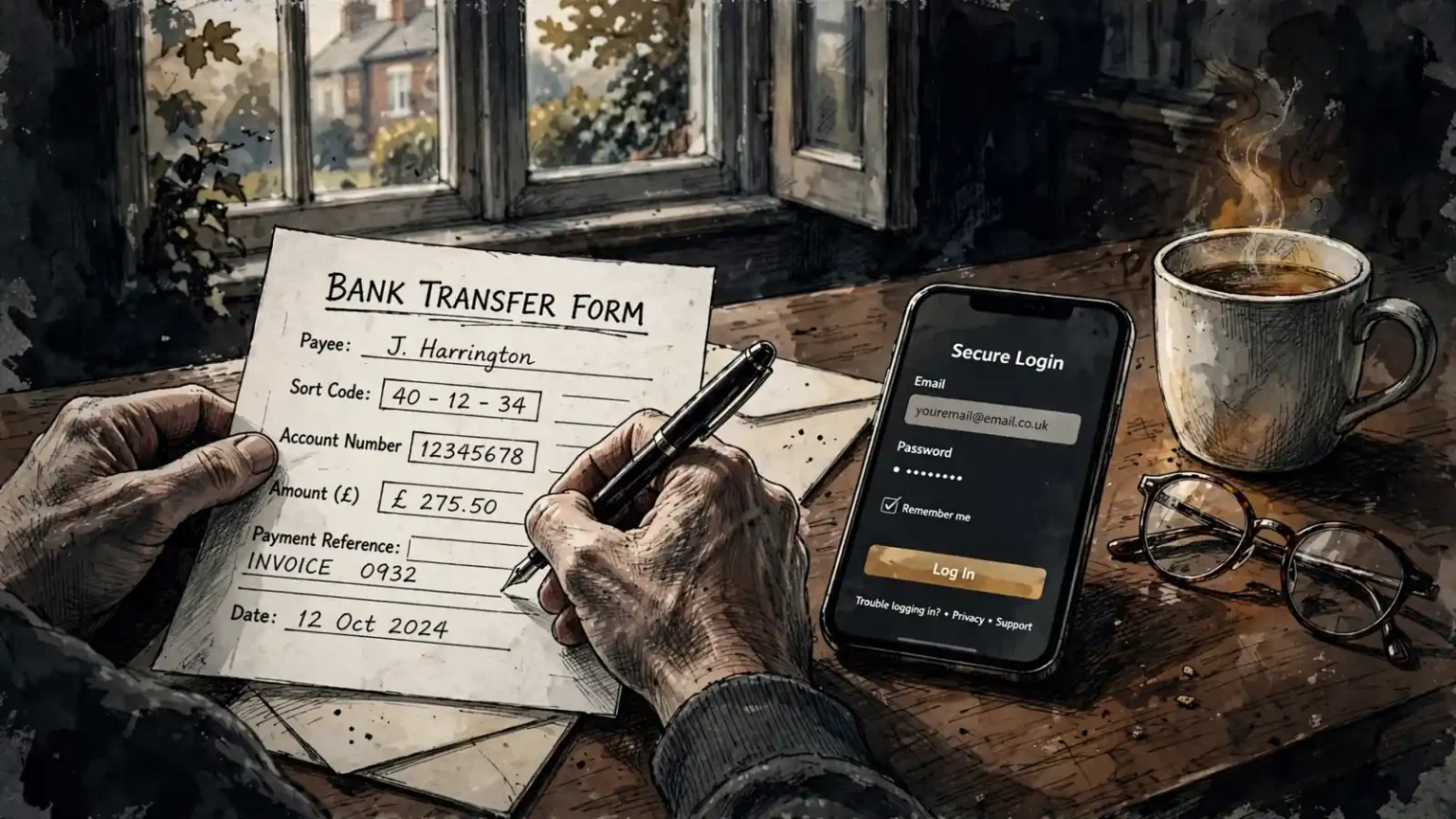
Bank transfer can mean a conventional payment or an open-banking instruction, with availability shaped by the casino cashier and account setup.
How Bank Transfers Fit Into a Casino Cashier
A casino cashier is not a universal menu. It is a set of payment routes configured by an operator, sometimes with different options for different accounts. Bank transfer sits alongside methods such as debit cards and e-wallets, but its presence cannot be inferred from a general description of how a casino accepts payments. The cashier is the working version of the offer.
That distinction matters because “bank transfer” can describe more than one payment flow. A conventional transfer may ask for bank details and involve the player’s banking service. An open-banking connection can instead pass a payment instruction between the bank and the casino through a connected service. Both may be described in broad terms as bank payments, while the steps, availability and handling differ. The label alone does not explain the route.
From the operator’s side, payment options are arranged around the casino’s approved providers and account setup. The public site may describe methods broadly, while the cashier presents only the routes available for the account and transaction in progress. This is why a list on a promotional page is not the same thing as a usable option in the payment screen. The cashier is where the general claim becomes operational.
Bank transfer also has a different place in the customer’s mental model from a card payment. It draws on a bank account rather than a card number, but that does not make it a single, standardised product across casinos. A site may support a bank-linked service without offering a manual transfer, or may describe a transfer route in terms that do not match another operator’s wording. “Wire transfer” is often used loosely in searches and reviews; in a UK cashier, the exact method name and instructions are more useful than the broad label.
Casinos That Accept Wirecard in the UK: What to Check
I have seen payment descriptions create false certainty. A page says that a casino accepts bank payments, and the reader assumes a familiar transfer option will appear after registration. The operator may mean a particular open-banking provider, or a route available only in some circumstances. The wording can be technically defensible and still leave the practical question unanswered. The screen decides.
Nor should the presence of a bank option be treated as a promise of one fixed experience. Specialist reviews have described open banking and bank transfers as capable of supporting instant deposits and fast withdrawals at many sites. That is a report about possible performance, not a guarantee for every casino or every account. The cashier’s named route, the operator’s terms and the bank service involved shape what happens in practice. A method category is not a service-level commitment.
This is the broader payment landscape: debit cards, e-wallets, prepaid options and bank-linked routes may all appear in casino cashiers, but not as a standard package. UK casinos commonly accept debit cards, including Visa and Mastercard. PayPal is recognised for speed and convenience, though a specialist review has noted that bonus eligibility can be excluded for that method; that point should be checked against the casino’s own promotion terms rather than assumed to apply everywhere. Paysafecard is a prepaid voucher for deposits only. Skrill and Neteller appear at some sites, with promotion conditions that can differ. Each option has its own role, and the list is not identical from one operator to another.
UK Casinos That Accept E-Wallets: Payment Guide
The comparison is not simply about which logo appears on a page. A cashier may distinguish deposit routes from withdrawal routes, and a payment name can be present in one context without being available for the other. The same broad category can also hide a provider-specific process. That is why a casino’s payment information should be read as a description of its setup, not as a market-wide rule.
For a UK player considering casinos that accept wire transfer, the useful starting point is therefore not a claim that all bank payments work alike. It is whether the specific casino identifies a bank-transfer route in its own cashier, and whether that route is described as a conventional transfer or a bank-linked service. Names matter. So does the screen they appear on.
A cashier is part of the casino’s operating infrastructure, not a neutral catalogue. The available methods reflect the operator’s provider arrangements and the account’s current options. That makes bank transfer one possible route among several, rather than a default feature of every online casino. The label is only the beginning.
Debit Cards
UK casinos commonly accept Visa and Mastercard debit cards.
E-wallets
PayPal, Skrill, and Neteller are common options, though terms may vary.
Prepaid Vouchers
Paysafecard is a common prepaid voucher used for deposits only.
Comparing Bank Transfers With Other Casino Payment Routes
A bank transfer is not automatically the slow, paperwork-heavy option its name can suggest. The label covers more than one payment experience: a conventional transfer and an open-banking route can work differently, and the cashier’s actual implementation matters. A specialist review has described some open-banking and bank-transfer options as allowing instant deposits and fast withdrawals at many sites. That is a report about certain services, not a promise that every bank transfer will move at that pace.
The useful comparison is therefore not “bank transfer versus instant payment” in the abstract. It is the specific route offered by a casino against the alternatives available in that same cashier. A bank-based service may combine a familiar source of funds with a quick authorisation flow; a conventional transfer may feel less immediate. The name alone does not settle which applies.
Bank transfers and debit cards
Debit cards are a familiar alternative. UK casinos commonly accept Visa and Mastercard debit cards, although that does not mean every card product or cashier will be eligible in every case. A card can feel straightforward because the payment method is already in use for ordinary purchases. A bank transfer, by contrast, may suit someone who prefers to move funds directly from a bank account rather than enter card details.
Neither description establishes which method is faster at a particular site. Some bank-based services are reported to support instant deposits, while card processing is determined by the operator and payment route in use. Convenience is similarly personal: one person may prefer a saved card, another may prefer selecting a bank account. The cashier decides what is actually available.
Casinos That Accept Tether in the UK: Payment Checks
The word “instant” needs care. It may describe the point at which the casino receives a deposit, not every step involved in setting up or authorising the payment. I would compare the wording shown for the exact method rather than assume that all options carrying a bank label behave alike. Small distinction. Material difference.
Bank transfers and e-wallets
PayPal is often valued for speed and ease of use, but its treatment in casino promotions is a separate question. A specialist review has noted that PayPal may be excluded from bonus eligibility. That is not a fixed rule across operators: the relevant promotion terms determine whether a particular payment qualifies. A payment route can be convenient and still have a condition attached to it.
Skrill and Neteller are other e-wallet names found at some casino sites. Their availability and promotional treatment are not universal, so they should not be treated as interchangeable with a bank transfer or assumed to be accepted by every operator. The practical comparison is about the cashier’s supported routes and the terms attached to each, rather than which category sounds most familiar.
E-wallets can be useful when an account is already set up and accepted by the casino. A bank transfer may appeal where keeping the payment connected to a bank account feels simpler. Neither preference determines withdrawal suitability on its own; the cashier’s rules govern which routes can be used for the relevant transaction. That is a separate check from comparing deposit convenience.
Deposit-only options and other routes
Paysafecard is a prepaid voucher used for deposits only. That makes it different from a bank transfer when considering the whole payment journey: a deposit-only method cannot serve as a complete route for both putting money in and receiving funds back. The distinction matters even when the deposit itself is easy to make.
Some UKGC-licensed casinos also accept Apple Pay for deposits, but support should not be assumed across the market.
Some UKGC-licensed casinos also accept Apple Pay for deposits, but support should not be assumed across the market. The same restraint applies to other payment names shown in general casino discussions. A method’s existence does not show that a specific site accepts it, or that it is available for every transaction type.
For a casino that accepts bank transfer, the meaningful comparison is thus practical rather than promotional. Is the offered route a direct bank transfer or an open-banking service? Does the cashier describe the deposit as instant, or simply list the method? Are the alternatives available at that operator, and do their terms differ? Those details answer more than a broad claim that one payment family is best.
I would not rank bank transfers, cards, e-wallets and vouchers as if each worked identically everywhere. A bank-based route may combine account familiarity with rapid processing at some sites; a debit card may be the more familiar option; PayPal may offer convenience while the promotion terms impose an exception; and Paysafecard is deposit-only. The right comparison is the one visible in the casino cashier, not a general league table.
Checking Whether Online Casinos Offer Bank Transfers
A payment method mentioned on a casino’s information page is not necessarily available in its live cashier. I treat the cashier as the useful check: it shows which routes the operator is presenting for that account, rather than which methods appeared in older promotional copy or a general payment summary.
Availability can depend on the route being used. A cashier may show separate choices for adding funds and requesting a payout, so seeing “bank transfer” in one place does not establish that it is offered for both. I check the relevant deposit and withdrawal screens separately. That distinction matters when looking for an online casino wire transfer option: the label alone does not tell the whole story.
Casinos That Accept Interac in the UK: What to Check
The account view also matters. A payment list shown before sign-in may be a general overview; after sign-in, the available choices may be specific to the account. The cashier is therefore a better point of reference than a banner, review page or search snippet. If the bank-transfer option is absent from the relevant screen, a general claim that the casino accepts it does not settle whether it is available for that transaction.
Read the cashier label, not just the headline
Operators do not always use identical wording. The option may be described as a bank transfer, a transfer from a bank, or through a named banking service. The practical check is whether the displayed route actually directs the transaction through a bank account, rather than assuming that every item containing the word “bank” is the same method.
I have seen payment pages compress several distinct routes into one short description. That can make a method look broader than it is. Open the option’s own details and check what action it offers. A bank transfer may be available for deposits while a different route is shown for withdrawals. Conversely, a cashier could list transfer services separately, so the presence of one should not be read as confirmation of another.
There is a second detail worth checking before the first transaction: the account’s currency. A specialist review has stated that GBP is supported, but that claim should not replace checking the currency shown in the account itself. If the account is set to another currency, a transfer may involve conversion. The currency displayed in the cashier and account settings is the practical confirmation.
Checking Availability
- Sign in to your account
- Open the cashier
- Inspect available methods for deposits
- Inspect available methods for withdrawals
- Check the account’s supported currency
Check the route at the point of use
A reliable check is narrow and concrete: sign in, open the cashier, and inspect the available methods for the action in question. If a bank-transfer choice is listed, read its accompanying terms and any displayed instructions. If it is not listed, do not assume that a general payment page overrides the live cashier.
The same caution applies to an online casino that accepts wire transfer claims found elsewhere. Payment options can change, and third-party descriptions may not reflect the current account screen. I use such descriptions as a pointer, not as proof. The cashier is the operator’s own presentation of what can be selected at that point.
For a withdrawal, look specifically at the withdrawal choices rather than inferring availability from the deposit screen. A deposit route and a payout route are not interchangeable just because both involve a bank. Where the cashier does not show the required route, the question is unresolved until the operator confirms it through its own support channel.
This check is about availability, not whether the route suits a particular transaction. The next step is to read the conditions attached to the option once it appears. First, confirm it exists. No guesswork.
What to Check Before Making a Bank-Transfer Deposit
Once a bank transfer appears in the cashier, the next question is whether its deposit conditions suit the amount intended. A payment route can be available without accepting every deposit size. The minimum and maximum may be set separately for each method, so a figure shown beside a debit card or e-wallet should not be assumed to apply to a transfer.
Casinos That Accept Entropay in the UK: What’s Confirmed
A specialist review I consulted puts minimum casino deposits at £10–£20, with the threshold depending on the selected payment method. That is a useful indication of the range reported in reviews, not a promise about a particular cashier. The live deposit screen is the operative reference: it can show a different minimum for a bank transfer, or a threshold that has changed since a review was published.
The practical check is simple. Select the transfer option, enter an intended amount, and read any validation message before confirming. Some cashiers display a minimum and maximum beside the amount field; others reveal whether the entry is acceptable only after it is typed. A rejected amount is not necessarily a problem with the bank account. It may fall outside the casino’s own permitted range for that route.
Maximums need the same care as minimums. A specialist review describes deposit ceilings as varying by payment method and account status, and distinguishes limits applied per transaction from those measured over a day or a month. Those are separate controls: a single transfer could fit the per-transaction ceiling while still being affected by an account-level cap. The cashier may not present every limit in the same place, so the terms attached to the payment screen matter as much as the general banking information.
Account status can also affect what is permitted. A limit visible during initial use may not be the only condition applied later, and a change to the account’s status can alter the available ceiling. I would treat any amount displayed in a promotional page or general payment guide as secondary to the current account cashier. It is the live route, not a broad payment summary, that determines whether a particular transfer can be submitted.
Do
- Select the transfer option in the live cashier
- Enter an intended amount to check validation
- Read any limit notices displayed
Don’t
- Assume deposit limits apply to all methods
- Assume a promotional page overrides the live cashier
- Guess the deposit limit without checking the screen
A failed attempt can have more than one explanation: the amount may be below the route’s minimum, above its transaction ceiling, or inconsistent with a broader account limit. Repeatedly changing the figure without identifying which condition applies can make a routine deposit harder to diagnose. The useful detail is the limit’s unit—per payment, daily, or monthly—and whether the cashier identifies it as method-specific or account-specific.
Before confirming, check the amount field, any limit notice, and the terms linked from that payment screen. If the cashier does not make clear which cap applies, the operator’s support team can clarify the applicable deposit condition before the transfer is initiated. No guesswork.
Keeping Deposit Details and Account Ownership Aligned
A bank-transfer deposit has two sides to its ownership record: the customer details held by the casino and the name attached to the bank account. When those point to the same person, basic checks have less reason to interrupt the transaction. When they do not, even a straightforward payment can raise questions that have nothing to do with the amount or the casino games.
I have seen payment problems treated as technical faults when the underlying issue was simpler: the account holder and the casino customer did not appear to be the same person. A difference in names or account details does not automatically establish wrongdoing, but it can make an operator pause to clarify who owns the funds. That is avoidable friction, not a useful shortcut.
WebMoney Casinos in the UK: What Boku Pages Prove
This matters whether the cashier describes the option as a bank transfer, wire transfer or bank wire transfer. The label does not change the basic ownership question. A casino that accepts wire transfer deposits still needs to associate the incoming payment with the customer account that initiated it. The cleanest arrangement is a personal bank account in the same name as the casino account.
Shared accounts, business accounts and payments initiated by another person can make that connection less clear. Their treatment depends on the operator’s terms and checks, so there is no safe assumption that a payment will be accepted simply because the bank has sent it. Nor does a successful deposit prove that the route will be suitable for every later transaction. The customer record and the payment record need to remain intelligible to the operator.
A consistent route can help. Using one named account for deposits and, where permitted, withdrawals gives the casino a clearer line between the customer and the funds. In industry language, this sits alongside closed-loop rules: operators may expect funds to move back through a source already associated with the account. Anti-money-laundering controls also commonly require payouts to return to the original payment source. That is a control on the flow of money, not a promise that every payment will be handled identically.
There can still be checks. An operator may need to establish ownership or resolve a mismatch before proceeding, and using matching details does not remove other account requirements. It simply avoids adding an unnecessary uncertainty to the payment trail. I would treat consistency as administrative hygiene, not as a way to bypass review.
Ownership Mismatch
Ensure your casino account details and bank account name are aligned to avoid transaction interruptions.
The practical distinction is between a payment that is clearly attributable to the casino customer and one that leaves the operator to work out whose money arrived. For a bank-transfer customer, keeping the registered casino details and the named bank account aligned is the more straightforward arrangement. One owner. One clear trail.
Receiving Casino Winnings by Bank Transfer
A bank transfer used to fund a casino account does not automatically become the route for every withdrawal. UK anti-money laundering controls generally require winnings to be returned to the original payment source. In practice, that means the cashier may direct a payout back through the method used for the deposit, rather than treating a bank account as a separate destination chosen at withdrawal.
The distinction matters when several payment methods have been used. A casino may apply closed-loop rules: funds are returned to the sources that funded the account, subject to its payment terms and any checks. If a bank transfer was the deposit route, casino winnings may be paid back to that account. If the deposit came from a card or another method, the cashier may instead require a return through that original source. The available route depends on the operator’s rules and the payment history on the account.
I have seen players assume that selecting “bank transfer” for a deposit settles the payout question too. It does not. The cashier’s withdrawal options and the original-source requirement are separate parts of the transaction. A different destination can involve additional verification, and an operator may not offer the requested route at all. A successful deposit is not confirmation that the same account can receive a withdrawal.
Casinos That Accept Bitcoin in the UK: Payment Checks
Speed is another point where the two directions are easy to confuse. A deposit can reach the casino quickly, but that says little about how soon winnings will reach a bank account. A specialist review has described the contrast between an instant card deposit and a payout taking several business days; that is an illustration, not a timetable that applies to every casino or payment route. The practical point is that incoming and outgoing payments follow different processes.
Before relying on casino winnings by wire transfer, the withdrawal terms should be read alongside the cashier’s current options. The relevant details are whether bank transfer is offered for withdrawals, whether the casino requires funds to return to the original source, and whether the named bank account matches the account holder. Those conditions determine whether a transfer is a usable payout route, not merely a listed deposit method.
This is where expectations need to stay modest. A transfer may be suitable for receiving winnings when the casino permits it and the account meets its requirements. It is not a promise of direct payment to any bank account, nor is a quick deposit evidence of a quick withdrawal. Same route, different journey.
Why Bank-Transfer Withdrawals Can Take Longer
A withdrawal has two clocks: the casino’s approval process and the bank transfer after release. The first is not the same as the time funds spend moving between financial institutions. A cashier may show a request as pending while the casino checks it; only after approval is the transfer sent onward.
A specialist review notes that withdrawal processing can take longer on a first request when verification is still being completed. That distinction matters. If KYC is incomplete, the casino may need to confirm identity or account information before authorising payment. The delay is then at the operator’s end, not evidence that the bank transfer itself has stalled. Later requests can still be subject to checks, so a previously completed withdrawal is not a fixed timetable.
Withdrawal Processing Factors
Withdrawal timing is affected by several factors:
- Casino-side approval and KYC verification
- Bank cut-off times and weekends
- Currency conversion processes
Once approved, delivery depends on the receiving bank and when the transfer enters its processing cycle. A specialist review also identifies bank cut-off times, weekends and currency conversion as factors that can affect arrival. A request released after a cut-off may not move through the same processing cycle as one released earlier. Weekend timing can add a pause, while a currency conversion may introduce another step between the casino’s payment instruction and the credited balance.
I have found that the status label is often more useful than an estimated arrival date. “Pending” generally points to casino-side handling; “processed” or “sent” indicates that the operator has released the payment, though it does not mean the bank has credited it. The labels vary by cashier, so they should be read alongside the operator’s stated withdrawal terms rather than treated as a promise of receipt.
This is why a casino wire transfer withdrawal may appear slow even when the casino has approved it promptly: the operator’s queue and the bank’s delivery process are separate. Conversely, a delay before approval should not be blamed on bank processing. For a wire transfer casino withdrawal, the practical check is to establish when the casino marks a request as approved or sent, then allow for the bank’s own handling.
Two stages. Different clocks.
The Costs Behind a Casino Bank-Transfer Payment
A transfer can appear free in the casino cashier and still carry a cost elsewhere in the payment chain. I separate the possible charges by who applies them: the casino, the payment provider, the sending or receiving bank, and any network involved. A specialist payment review also identifies exchange-rate spread as a cost to check, not just an advertised transaction fee. The cashier shows only part of the picture.
Casinos That Accept Giropay in the UK: What to Check
A flat fee is the easiest charge to spot. It may be listed beside the transfer option or in the payment terms, but that does not establish the total cost. A bank or provider may apply its own charge, while an issuer or network can add another. Whether any of these applies depends on the route and the account terms, so a cost shown by one service should not be assumed to cover the others.
Currency conversion needs separate attention. If the casino account and the bank account use different currencies, the exchange rate applied to the transaction can include a spread: the rate may be less favourable than the one used as a reference. A specialist payment review notes that this difference can exceed a visible flat fee. The fee is not always the main cost.
I check the account currency and the rate that will be used before comparing routes. A casino displaying a transfer option does not, by itself, show whether the transaction will be converted or which party sets the rate. Where the cashier or provider gives a conversion figure, compare the amount leaving the bank with the amount credited to the casino account. That reveals more than looking at a fee label alone.
There is no payment method that can be called the cheapest in every case. A specialist payment review recommends comparing casino charges, provider fees, currency spread and network costs against the actual transaction amount. The same route can work out differently when the amount or currency changes. Compare like with like.
Total Cost
The true cost of a transfer is the total amount deducted across the entire payment chain.
For a wire transfer payment to a casino, the practical calculation is therefore the total deducted across the chain, not simply whether the casino advertises a fee. If the terms do not make the rate or third-party charges clear, the apparent price is incomplete. I treat that as an unresolved cost, not as proof that the transfer is free.
UKGC Rules That Matter for Bank-Transfer Casinos
A bank transfer does not put a casino account outside the gambling safeguards. For remote gambling licensees serving Great Britain, the payment rail changes how money moves; it does not remove the operator’s duties under the UK Gambling Commission’s rules. I separate those two things because cashier pages can make a payment method look like the main decision, when the account controls matter just as much.
One requirement appears before play begins: a remote operator must prompt a new customer to set a financial limit before the first deposit. The account must also provide accessible controls for managing limits later. These are account-level safeguards, not special terms attached only to a bank wire transfer casino in the UK. The cashier may show the transfer route, but the operator’s wider obligations still apply.
The distinction matters in practice. A payment method can be available while the account still needs its financial-limit prompt completed. Seeing a bank-transfer option is not evidence that the casino has met every requirement, nor does it replace checking the operator’s regulatory status. Before depositing, the licence number should be checked against the UKGC public register. A licensed operator must also provide responsible-gambling tools, including self-exclusion, and an internal complaints process with access to an approved Alternative Dispute Resolution service.
Credit-card payments for gambling remain prohibited. The regulator introduced the ban on 14 April 2020, and it has not been relaxed. Remote operators cannot accept credit-card funding for gambling, including when the payment is routed through a money service business. The restriction also covers wallet payments where the wallet allows credit-card funds to be used for gambling. A transfer should not be treated as a workaround for that rule; the relevant question is whether the underlying funding route is permitted.
I read the UKGC framework as applying to the account and operator, not as an endorsement of a particular payment method. A UKGC casino bank transfer can be one permitted cashier route, but it does not certify the casino on its own. Licence status and account safeguards are the substance. The transfer is just the rail.
What Makes a Bank-Transfer Casino a Practical Fit
There is no useful universal “best” bank-transfer casino. A practical fit is the one whose live cashier supports the intended account currency and shows workable terms for the payment route. I treat a general payment page as a starting point, not confirmation: the cashier is where a method’s current availability becomes relevant to an actual account.
Currency deserves an early check. A specialist review may list GBP as supported, but the account’s selected currency still needs confirming before the first transaction. If the account is set to another currency, conversion can enter the transaction even when the bank account itself is in pounds. That is a preventable complication, not a feature.
The same distinction applies to cards. A specialist review may name Visa or Mastercard, but that does not establish that every card product is currently eligible in the UK or available to every customer. The cashier’s terms matter more than a broad logo list. I look for the payment route, the currency shown for the account, and any conditions attached to that route before treating a casino as suitable.
A good fit is therefore specific, not a league-table position: the bank-transfer option is actually presented, the account currency is clear, and the displayed conditions match the intended use. If one of those points is vague, the decision is not yet settled. Marketing copy can describe a broad service; the cashier defines what the account can do.
The final check is simple, though not glamorous. Confirm the details in the account itself, then judge the casino on those terms rather than on a headline claim. No guesswork.
Why must withdrawals return to the deposit method?
Returning funds to the original payment source is a common anti-fraud and anti-money-laundering control. Using the same account for deposits and withdrawals can also reduce avoidable verification issues.
What is the fastest withdrawal method for UK casinos?
PayPal, open-banking services and debit cards connected to fast-payout systems are generally among the quickest. Actual timing also depends on casino approval and whether your account is verified.
Can I deposit in GBP?
Yes, GBP is supported. Check your account currency before depositing to avoid conversion costs.
What is the current minimum deposit?
The minimum deposit usually starts at £10–£20, depending on the payment method.
Are Visa and Mastercard deposits definitely debit cards?
No. Visa and Mastercard are commonly accepted for debit-card deposits, but check the cashier to confirm that your particular card product is eligible.
Can I use a credit card at 333 Casino in Great Britain?
No. Credit-card gambling has been prohibited in Great Britain since 14 April 2020.
Is Skrill available?
Yes, Skrill is one of the common deposit methods at UK-friendly casino sites, though availability and promotion eligibility vary by casino.
Which method has the lowest fees?
There is no universally cheapest method. Compare casino and provider charges, bank or issuer fees, currency-conversion spread and any network costs for the payment you plan to make.